
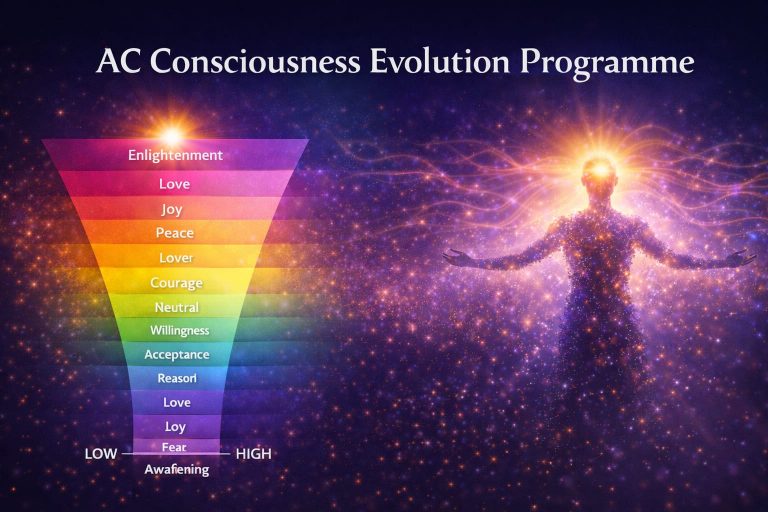
The Map of Consciousness by Dr. David R. Hawkins
The Map of Consciousness is a conceptual framework that explains how human awareness expresses itself through emotions, attitudes, behavior, and perception. It proposes that consciousness is organized into identifiable levels, ranging from contracted states such as fear and shame to expanded states such as love, peace, and enlightenment.
Rather than focusing on intelligence or education, the map explains how life is internally experienced. This understanding forms the foundation of the AC Consciousness Evolution Programme .
Brief Context of the Work
The Map of Consciousness was formulated by Dr. David R. Hawkins, a psychiatrist and consciousness researcher. While not a scientific measurement system, it is widely used as a psychological–spiritual model for understanding human behavior and awareness.
The Structure of Consciousness Levels
- Dominant emotional patterns
- Typical reactions to life
- Degree of ego involvement
- Relationship to responsibility and truth
Movement through levels does not occur through force or discipline, but through awareness and release. This principle is explored practically in our Consciousness Evaluation Tool .
Lower Levels of Consciousness (Below 200)
Shame (20)
Guilt (30)
Apathy (50)
Grief (75)
Fear (100)
Desire (125)
Anger (150)
Pride (175)
The Turning Point of Consciousness
Courage (200)
- Responsibility replaces blame
- Fear no longer dominates decisions
- Inner stability begins
Higher Levels of Consciousness (Above 200)
Neutrality (250)
Willingness (300)
Acceptance (350)
Reason (400)
Love (500)
Joy (550)
Peace (600)
Enlightenment (700–1000)
Final Insight
The Map of Consciousness does not promise instant success. It reveals that as awareness rises, perception changes, and life reorganizes naturally.